
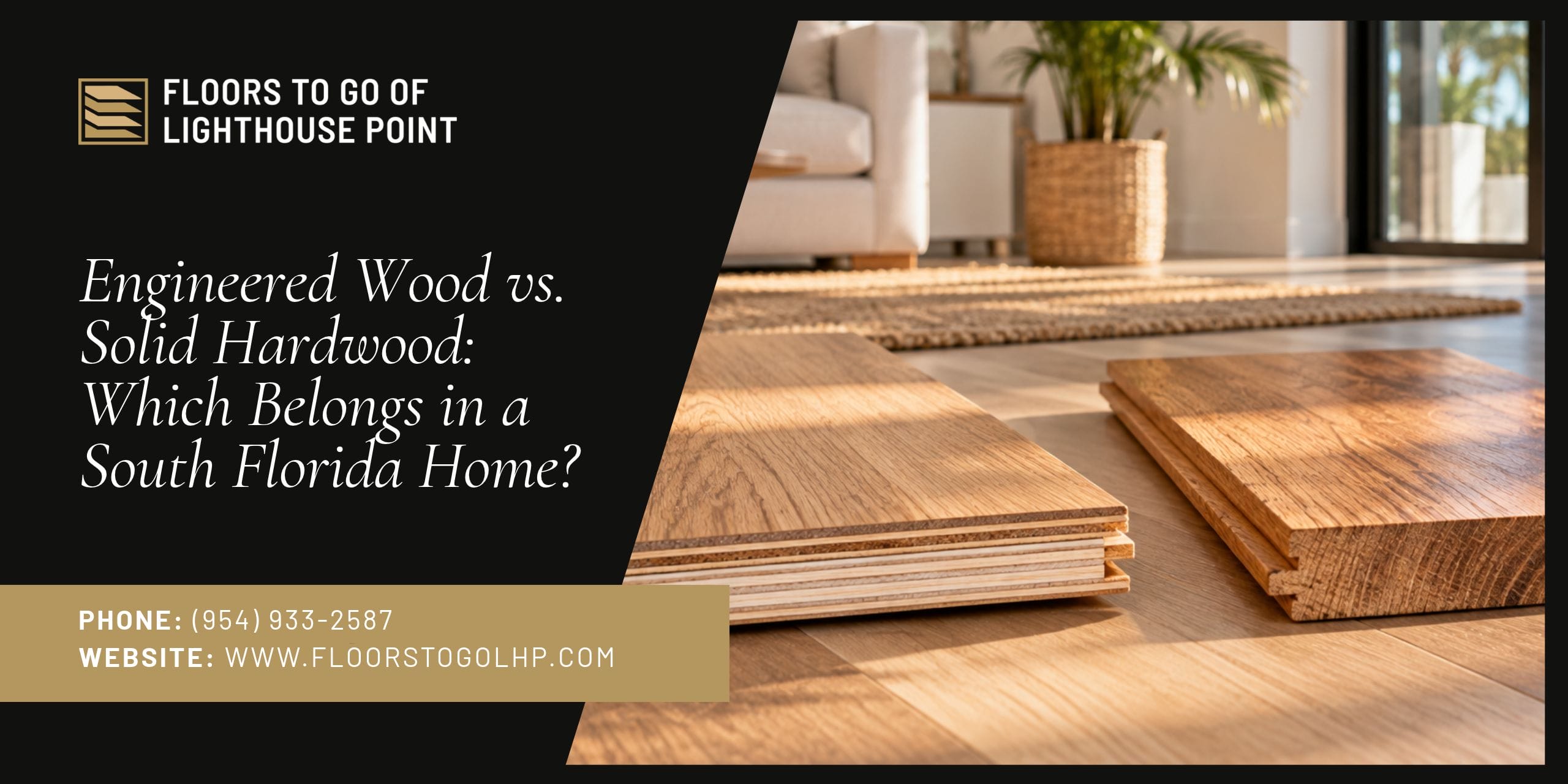
Choosing engineered hardwood or solid hardwood goes beyond being a style decision. In South Florida, it determines how long your floor will last. That’s why you need someone who will be honest with you.
Kenny Teich, co-owner of Floors To Go of Lighthouse Point, is straightforward. Let’s get into it all.
Why Solid Wood Struggles With Humidity
Solid hardwood is exactly what you think it is; each plank is milled from a single piece of timber. That’s part of its appeal. However, it’s also the biggest weakness in the humidity of Southeast Florida. Since each plank is made from one continuous piece of wood, it reacts to humidity as a single unit. When moisture levels shift, the entirety of the plank expands and contracts together.
Uniform movement can be a big risk. There are no layers to counteract the shift. As a result, solid wood is more likely to buckle or develop issues over time, especially with constant humidity daily instead of occasionally. The most common issues tend to be cupping, gapping and warping. Sometimes, sections of flooring have to be pulled up, reordered and reinstalled, which is an expensive fix for a problem that’s difficult to catch before it starts. South Florida doesn’t have a dry season, which puts solid wood under constant stress instead of simply reacting to the occasional seasonal swing.
How Engineered Wood Solves the Problem
On the surface, you can’t tell engineered wood apart from its solid counterpart, but it’s built differently underneath. The top layer you walk on and see is made from real wood and sits above multiple layers of cross-layered wood that run in a different direction from the one below.
The crisscross makes a difference. When humidity changes, the entire plank doesn’t move in one direction. Instead, the layered structure works against itself so the wood remains more stable. It expands and contracts much less than solid hardwood, even under the same humidity conditions. Stability is the reason engineered wood is a better match for the concrete slab foundations common in South Florida homes, which is why solid hardwood isn’t recommended for installation directly over concrete.
Why You Should Go With Engineered Wood, Every Time
In South Florida, engineered wood comes out on top over solid hardwood every time. That’s not to say solid hardwood isn’t a good product. It’s a matter of recognizing what this specific climate demands. At Floors To Go of Lighthouse Point, we help you find a floor that performs through Florida’s humidity, which in many cases, can be engineered hardwood. It’s one of the main reasons engineered wood makes up most of what we actually install, not just what we recommend in theory.
Considering a hardwood floor for your South Florida home? Contact us or visit our showroom to talk through your options.